Chapter 7: Ash on the Wind
Gnaw’s Edge was not a border so much as a wound—raw, trembling, and still bleeding.
Here the earth narrowed to a scorched ribbon, stretched taut between lands wracked by elemental trauma. To the west, the Scorched Outskirts still seethed with ruin, its embers barely cooled from the devastations wrought by warbands that had clashed like gods. To the east loomed the Hateful Shores—riven cliffs and tide-burnt highlands where the realm’s essence pulled apart like frayed cloth. And in between them, like a drawn blade poised above a beating heart, lay the Burningbridge.
It groaned with pressure—tectonic plates grinding against veins of emberstone, ley-lines pulsating like trapped nerves beneath cracked basalt. The sky over Gnaw’s Edge was never silent: winds shrieked through the pass, carrying sulfur, whispers, and the ever-present scent of ash.
It was here that the fate of the Emberpyre would be decided.
They came, as before, not by coincidence, but convergence.
Emberkin the Incandescent, whose ambition had once burned in rhythmic cadence with prophecy, now wandered the edge of delirium. His mind, once a lattice of fate-readings and ritual precision, crackled with voices—some daemonic, some divine, some perhaps his own. He had fled the Scorched Outskirts reeling, his Cabal battered but not broken. The Emberpyre—his flame-forged altar to ascension—had been sabotaged, its crescendo denied by treachery and intrusion.
But to Emberkin, this too had been foretold. The path to glory was never straight. It twisted, like wyrdflame in the wind.
He believed the Burningbridge was no longer a route. It was a rite.
Across the ash-worn landscape, others gathered.
Chak’Tal, the Seraphon general whose scales bore the starlight of ancient design, had watched the Emberpyre rise with unease. Its flame did not match the calculations of the stars; it emitted signals beyond celestial accounting. After his force was repelled in the west, he had returned to the void-chambers, seeking vision. But the constellations refused to align. They danced erratically—coiling, fracturing. Some moved in reverse.
Now he marched again. Not to simply destroy Emberkin’s works, but to seal the corruption he feared would ripple across the ley-lines and fracture reality’s skin.
He did not know if the stars would follow him. But he would walk forward, regardless.
And from the shadows emerged the Knights of the Long March, undead revenants of cold blood and colder purpose. Their leader, the Earl of Execution, still wore the scars of failure—failure to slay Emberkin, to capture his flame, to elevate his banner in Vhordrai’s name. But he had learned. He had tracked the Cabal to Gnaw’s Edge and seen what their rituals had almost become.
He would not make the same mistake again.
This time, he did not ride alone.
In a rare act of diplomacy—or manipulation—he had courted the aid of Pontifex Zenestra, Matriarch of the Great Wheel. Her pilgrimage had taken her near the Emberpyre’s ash-wake, and the Earl had whispered truths into her ear: of heresy, false flame, of divine fire twisted into daemonic vanity.
She had listened. And where she marched, cannons followed, and the faithful screamed prayers that split the heavens.
Each army came with their own truth. Each believed they were right.
And the land itself cared for none of it.
The ashstorms began three days before the first battle, whispering of omens and kindling the scattered embers of the dead. From the burning hills to the fractured coasts, a veil of smoke crept across the Burningbridge like a funeral shroud.
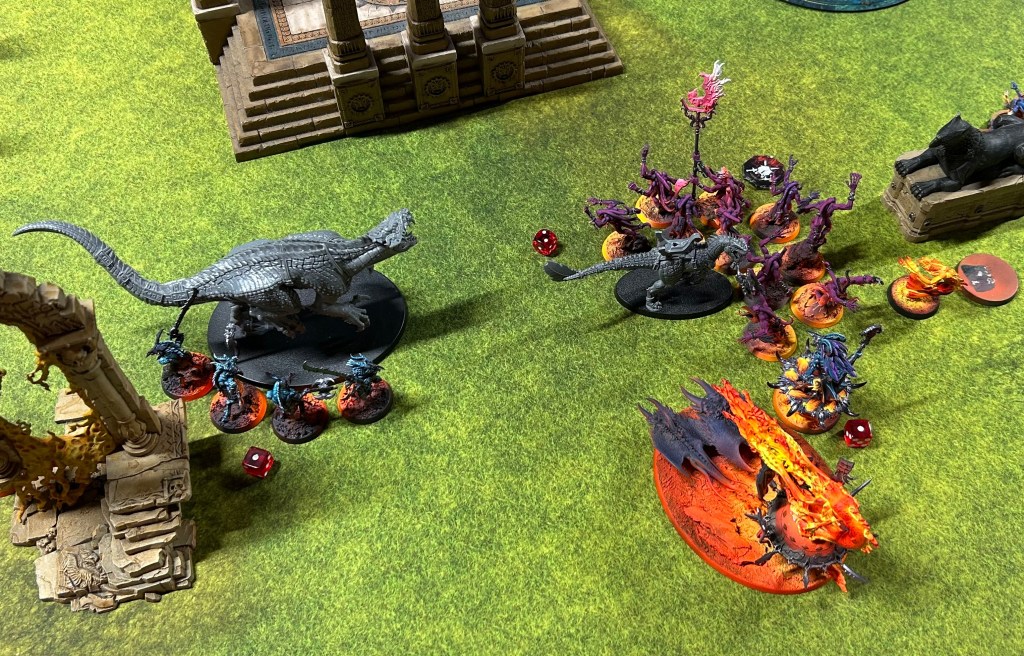
By the time Emberkin lit his staff atop the smoldering archway and Chak’Tal’s Carnosaur bellowed into the fog, it was no longer a battlefield.
It was a threshold.
And none of them would cross it unchanged.
Chapter 8: The Cinder Squall
The wind came first—dry, metallic, and shrieking across the basalt in arrhythmic surges.
Chak’Tal stood motionless atop a ridge of vitrified stone, the cracked remnants of some ancient eruption spread out beneath his clawed feet. Below him, the Burningbridge unfurled in a snaking line—its flanks ragged with tectonic scars, its surface etched with glowing veins of emberstone that pulsed faintly in the dimming light.
Behind him, his cohort assembled in ordered silence. Aggradons rumbled into formation, their bestial rage barely dormant beneath ash-shrouded skies. Cohorts of Saurus warriors moved with the slow certainty of glaciers. Skinks flitted between them, whispering readings from distorted astroliths and charts that no longer aligned with reality.
“The stars are wrong, general,” hissed one priest, his eyes wide with reptilian unease.
“They swim backwards. And some… are missing.”
Chak’Tal said nothing for a moment. His golden helm reflected the drifting grey above, and the pressure of the squall compressed his chest like unseen hands.
“Then we do not follow the stars,” he said at last.
“We follow the fire.”
He stepped forward, his spear-tip glowing faintly as it neared the emberstone veins below. The signal was clear now. The corruption ahead was not merely spiritual—it was geomantic, coiling itself around ley-lines like strangling roots.
They descended into the veil of ash without a roar, without fanfare. Only the faint chiming of obsidian underfoot and the breathless tension of divine silence accompanied them.
On the far side of the bridge, cloaked in smoke and half-shadow, Emberkin the Incandescent inhaled deeply.
His breath steamed despite the heat, curling up into the air where it danced with sparks from a burning Brimstone Horror. Around him, the remnants of the Flameborn Cabal prepared as they always did—in song, in ritual, in madness. Flames guttered low in the cracked bowls of his acolytes. The air shimmered, but not from heat—it shimmered with intention.
“The veil is drawn,” he whispered. “They walk in blindness. We burn in vision.”
He placed his palm against the rocky spine of the bridge and felt it—the tremble of convergence, the murmurs of daemonic fate spiraling outward from the emberstone seams.
“This is not a crossing,” he said to no one in particular. “This is a womb.”
A Flamer beside him giggled and caught fire. Emberkin did not flinch.
“Let them come.”
The cinder squall fell in earnest as the two forces collided—a wall of ash and embers, so dense that it swallowed the horizon and painted the sky in a dull orange fog. Visibility fell to nothing. Ranged weapons failed. Even celestial guidance vanished in the storm’s choking grip.
But Seraphon needed no prophecy to kill.
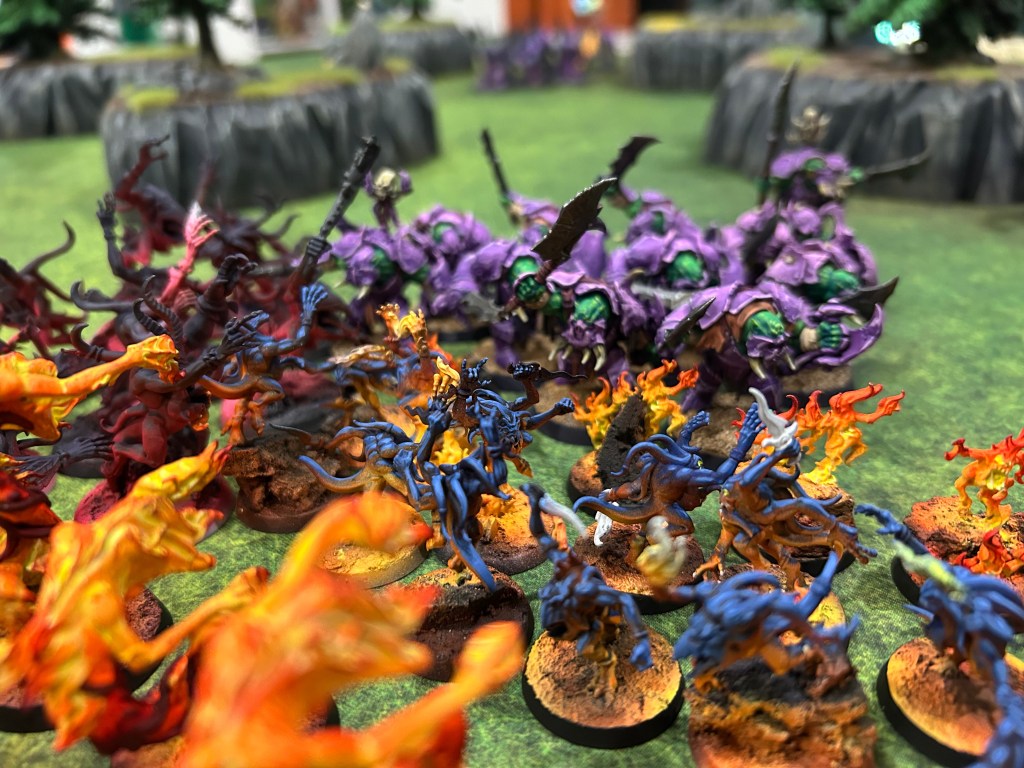
Chak’Tal’s warriors surged across the bridge in waves—feral, relentless, purposeful. Their heavy jaws snapped through screaming Pink Horrors, whose forms multiplied in maddening fractals. Saurus Guard formed wedges of scale and steel, driving forward inch by inch through wyrdflame and cackling fire.
But the Cabal fought like fire itself—dispersing, reforming, dancing through gaps with cruel synchronicity. The ashstorm did not hinder them. It sustained them. Emberkin wove spells from smoke and spark, hurling warpfire across the bridge with arcs of mutative brilliance. Each plume blinded, burned, or bent reality around it.
At one point, Chak’Tal was cut off from his vanguard—lost in a swirl of choking air and half-visible daemons that flickered like mirages. He roared a challenge and impaled a Flamer through its leering mouth, even as his skin blistered beneath sorcerous heat.
Behind him, his aggradons fell to a chorus of Horrors, their giggling voices rising into mockery:
“Your stars don’t shine here, lizard-thing! The fire speaks now!”
When the squall began to recede, the bridge was slick with blood and ember-melted stone. Cracked and glowing ley-lines sparked beneath collapsed bodies. Of Chak’Tal’s force, perhaps half retreated—dragging wounded through soot and silence.
But Emberkin remained standing—his robes in tatters, his crown askew, his eyes alight with fanatic joy.
“It has begun,” he muttered.
“They came with silence. We answered with flame.”
He turned to his followers, now fewer but somehow brighter—as if they had fed on the battle itself.
“We cross.”
Chapter 9: The Fire and the Wheel
The emberstone bridge still smoldered, fractures glowing faintly beneath the blackened sky.
The wind had shifted. The ash storm had passed, but in its place came something stranger—a humming, like heat trapped beneath skin, like prophecy stuck between teeth. It wasn’t the calm after a storm. It was the feeling before a second one.
High above the central span of the bridge, Emberkin stood in silent rapture, his daemonic retinue scattered in ritual poses below. The victory over the Seraphon had not healed him—it had transformed him. The ash still clung to his skin in fractal patterns, as though Tzeentch Himself had written runes into his flesh.
The Emberpyre’s pulse echoed faintly through the emberstone veins beneath his feet, but it was distant, like a heart struggling to beat behind ruined ribs. Its rhythm was fading. The Pyre had not survived the Scorched Outskirts unscathed.
He would need a new anchor. A stronger focus. A final ignition.
“There is no straight path to glory,” he whispered, palms outstretched to the ashen sky.
“Only the spiral. The spiral, and the flame.”
At the northern edge of the bridge, they watched him—two forces, uneasy allies, bound by blood and ambition.
The Knights of the Long March stood in funereal stillness, their vampiric mounts pawing at stone as if the ground itself offended them. At their front sat the Earl of Execution, motionless as a statue, his helm obscuring eyes that hadn’t blinked in an age.
Beside him, borne aloft on a palanquin of shrieking flagellants, was Pontifex Zenestra, Matriarch of the Great Wheel. Her halo of gilded wheels turned slowly, humming in tempo with her whispered litanies.
Their meeting had not been warm. But it had been productive.
“He bends the flame to his will,” the Earl had told her. “He has made a god of fire and daemons. Is this not heresy made manifest?”
“Blasphemy,” Zenestra had hissed. “The flame is sacred. The wheel turns upon it. This… Emberkin… must be broken.”
“Then let us turn the wheel together,” the vampire had said, bowing low enough to conceal his smile.
Now, the two stood shoulder to shoulder as the last of their formations took position. The hooves of Freeguild Cavaliers rumbled, ironweld cannons locked, and torch-bearing zealots shrieked praises to their Matriarch. Among the undead, Blood Knights gleamed crimson, their blades hungry with old memory.
They would purge the heretic. For faith. For vengeance. For gain.
They struck at dusk, when the emberlight shimmered strangely across the basalt.
The first volley of cannon-fire tore through a line of Blue Horrors, vaporizing them in a splash of shrieking sparks. Behind the blast, Blood Knights charged, lances low, their steeds breathing mist and malice.
But the bridge responded.
The energies beneath the Burningbridge had steeped in emberstone and wyrdflame for too long. As the battle erupted, some soldiers began to glow, not with magic, but with something older—a corruptive vitality rising from the stone itself.
The twist surged through the ranks like a second heartbeat.
Cities of Sigmar soldiers, mid-prayer, screamed as their skin turned translucent, veins coursing with molten heat—but they stood faster, struck harder.
A Knight of the Long March, cleaving through a Flamer, laughed aloud—a rare sound—as his blade seared with emberlight and left a trail of after-images.
Even Zenestra’s entourage felt it. Her voice echoed unnaturally as she called out rites of judgment, and her halo spun faster than before.
Emberkin knew.
From the moment the empowered zealots surged through his front lines, he knew the flame was turning against him.
“No, no,” he whispered. “The fire is mine. I am its vessel. I—”
But the Pyre did not answer. Or perhaps it answered too well, gifting its boon to the strongest will, regardless of loyalty.
Emberkin screamed and hurled a tide of wyrdflame across the bridge, consuming a detachment of Blood Knights and igniting a great cannon from within. Horrors danced around him like moths, shielding him from blades and bullets alike. His crown flickered. His staff cracked.
Then came the Earl, cutting through the last of the Cabal.
They did not duel. There was no clash of heroes. Only chaos—and escape.
Emberkin vanished into the smoke, carried off by shrieking Brimstone Horrors and the coiling tailwinds of his own sorcery. The flame did not die. But it flickered, for the first time, in fear.
The Burningbridge stood silent—cracked, scorched, and bleeding sparks.
Zenestra knelt in the ash and declared it purified, raising her scepter as her followers sang through bloodied teeth. But her eyes shone too brightly. Her voice rang too loud.
“Was it victory?” the Earl asked no one in particular.
“Or just a deeper curse?”
He mounted his steed and turned from the pyre-lit dusk. He had not claimed the Emberpyre. But he had seen its shadow.
And that, he thought, might be enough—for now.
Epilogue: The Threshold Fractured
The Burningbridge did not break.
It twisted.
Even as the last hoofbeats faded and the final screams were swallowed by soot, the land beneath the narrow pass pulsed with a rhythm not its own. Something had changed. Not just in the stone, but in the realm’s memory—a ripple of resonance echoing through the ley-lines, through emberstone veins, through fates not yet written.
Victory had been claimed. Twice.
But no one had crossed unscathed.
Chak’Tal returned to the void-temples bearing ashes instead of stars. His warriors had not failed—but the heavens had grown silent, and he could not forgive that silence. The Seraphon would strike again, but this time not with celestial grace.
They would strike with wrath.
The Knights of the Long March retreated in glimmering silence, their plate armor dimmed by the smoke of victory. The Earl of Execution rode at their head, carrying no trophy, but something better—knowledge. He had seen the shape of Emberkin’s transformation, the rhythm of his ritual, the cracks in his resolve.
The next time they met, he would not come to destroy the Emberpyre.
He would come to usurp it.
Zenestra left the bridge in song, her holy retinue dragging wreckage behind them to construct shrines along the road. She claimed the Burningbridge as a sanctified crossing, a place where heretics burned and the Great Wheel turned red with cleansing flame.
But even she noticed how some of her priests no longer slept.
And Emberkin… Emberkin fled not in shame, but in vision.
The bridge had not broken him—it had shown him the next gate.
The Emberpyre’s heart still beat, but faintly. He needed a new spark, something stronger than emberstone, stronger than belief. He whispered its name in the smoke as he walked alone.
“The Hateful Shores…”
There, at the jagged edge of Aqshy’s broken coast, the flame would rise again—not as a beacon, but as a blade. The Pyre would not burn upward.
It would reach outward.
This entry chronicles the narrative from our group’s ongoing Path to Glory: Ravaged Coast campaign, set in the world of Warhammer Age of Sigmar. All settings, factions, and lore are part of the rich universe created by Games Workshop. We’re here to paint minis, roll dice, and let myths be forged.

 Myth Forged Gaming
Leave a comment